Loving Mother and Children Silhouette
A Quiet Moment, Not a Cliché
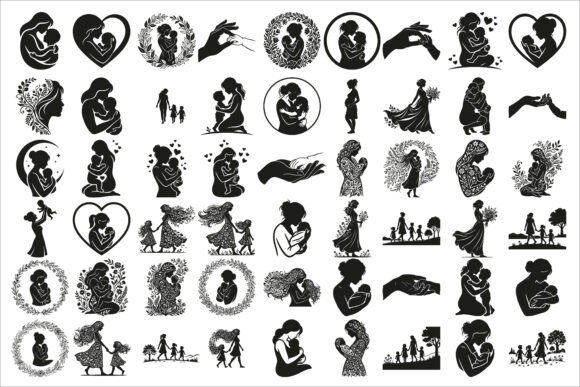
When I first opened Loving Mother and Children Silhouette, I wasn’t looking for “cute.” I was checking whether it held quiet intention—whether the curve of the mother’s shoulder, the tilt of a child’s head, or the spacing between figures felt intentional enough to translate cleanly into thread. It does. This isn’t a generic clipart family; it’s a single, fluid silhouette with gentle negative space between forms, soft contour lines, and balanced weight distribution. The elegance comes from restraint: no facial features, no props, no distracting outlines—just presence. That makes it unusually versatile for embroidery, where simplicity often survives stitching better than complexity.
Where It Lives Best: Real Projects, Real Fabric
Last week, I stitched Loving Mother and Children Silhouette onto a natural linen tea towel for a boutique gift set. No appliqué, no embellishment—just a clean 3.8" wide fill-stitch version in matte ecru thread on oat-colored fabric. The result? Calm, warm, and unmistakably handmade—not mass-produced. That’s the sweet spot: nursery decor, baby milestone blankets, minimalist aprons for new moms, or even subtle sweatshirt embroidery on the left chest of an oversized crewneck. It reads as tender without tipping into sentimentality, which matters when you’re selling to discerning Etsy buyers or local craft fair shoppers.
I also tested it as a small embroidered patch (2.2" tall) on cotton twill—ideal for tote bags or denim jackets. Because the design avoids fine interior details (no tiny hands, no overlapping limbs), it held up beautifully at that scale. No stitch crowding, no skipped areas, and the satin-stitched outer edge stayed crisp. That’s rare for silhouette-based machine embroidery designs, especially in the Crafts category where many files sacrifice clarity for visual flair.
Where to Pause—and Plan Ahead
This design shines on stable, medium-weight fabrics: quilting cotton, linen, canvas, midweight knits. But it asks for attention on stretchy or textured surfaces. On a ribbed baby onesie? Use cutaway + tear-away stabilizer combo—and reduce stitch density slightly in your embroidery software if your file allows edits. On dark fabric? Test thread contrast early: a light heather grey or ivory works better than stark white, which can look harsh against charcoal or navy.
It’s not ideal for curved surfaces like caps unless resized carefully below 2.5". The silhouette’s base is subtly wider than its height, so distortion creeps in on tight curves. Likewise, avoid placing it near seams or darts on custom apparel—the negative space between figures needs breathing room to read clearly. And while it’s lovely on kitchen towels, skip ultra-thin tea towels (<180 gsm) unless you reinforce with iron-on backing: delicate fill areas can shift or pucker without proper support.
Design Integrity Meets Customer Trust
When your buyer sees Loving Mother and Children Silhouette on a product listing—say, a hand-embroidered pillow cover—they’re reading more than a motif. They’re sensing care, cohesion, and emotional resonance. That builds trust. A poorly digitized silhouette looks hollow or lopsided after stitching; this one lands with grounded grace. That professionalism elevates your entire craft business, whether you’re an Etsy seller bundling digital embroidery files or a local maker stitching personalized gifts for new parents.
It also scales well across formats. As a digital embroidery file, it works cleanly in printable mockups—no jagged edges, no pixelation at 300 dpi. As a Graphics asset, it adapts smoothly to laser-cut wood ornaments or Cricut vinyl decals, extending your product line without redesigning. Just remember: if you’re selling finished items commercially, verify the license permits resale of physical products—not just personal use.
Practical Notes from the Hoop
- Always test first—on scrap fabric matching your final project’s weight and stretch.
- Check thread color contrast in natural light, not just on screen. What looks soft on monitor may vanish on oat linen.
- Review stitch density before hooping—especially if layering over textured fabric. Overly dense fills can stiffen delicate items like baby swaddles.
- Confirm hoop size compatibility. At standard sizes (3.5–4"), it fits most home machines—but double-check if using a compact or industrial setup.
- Inspect small details manually: are inner curves smooth? Does the base sit flat without floating threads? These impact finish quality.
- Test black-and-white mockups to gauge how it reads on light vs. dark backgrounds—critical for branding consistency.
- Use appropriate stabilizer: cutaway for knits, tear-away for stable wovens, fusible for lightweight linens.
- Verify commercial rights before listing as a finished product or reselling the embroidery file.
More Than a Mother’s Day Trend
Loving Mother and Children Silhouette avoids seasonal expiration. Yes, it’s perfect for Mother’s Day crafts—but it’s equally strong for baby showers, adoption announcements, foster family gifts, or quiet keepsakes for grandparents. Its timelessness comes from what it leaves out: no dates, no slogans, no trend-driven fonts. That makes it a reliable anchor in your design assets library—not a flash-in-the-pan embroidery project, but a quietly enduring one.
For makers who value both heart and craftsmanship, this silhouette doesn’t shout. It settles in. And in embroidery—where every stitch carries intention—that kind of quiet confidence is everything.