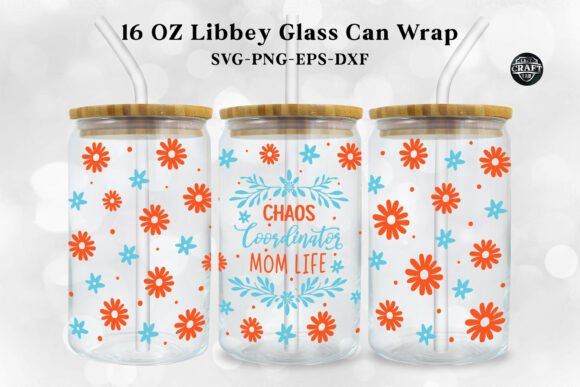
Chaos Coordinator Mom Life Can Wrap SVG
A Designer’s First Look: Playful, Punchy, and Purpose-Built
Opening the Chaos Coordinator Mom Life Can Wrap SVG file felt like flipping open a well-worn notebook from a fellow maker — familiar, warm, and just a little bit chaotic in the best way. It’s not delicate script or minimalist line art; it’s bold, conversational, and built for visibility. The layout leans into the wrap format naturally — curves follow the implied cylinder of a 16 oz Libbey glass, with letter spacing and weight distribution that suggest intentional flow, not just flat scaling. As a designer who’s stitched hundreds of “mom life” motifs — from subtle watercolor florals to sassy iron-on patches — this one lands differently: it doesn’t whisper “I’m tired.” It grins and says, “I’ve got systems… mostly.” That tone matters — especially when you’re translating it into thread.
Where It Shines: Real Projects, Real Stitching
I tested the Chaos Coordinator Mom Life Can Wrap SVG as the centerpiece for a custom embroidered tote bag — the kind small shops sell at farmers’ markets or boutique gift shops. On medium-weight canvas with tear-away stabilizer, the design stitched cleanly: no puckering, no skipped satin stitches on the curved “Mom Life” banner, and crisp edges on the coordinating doodle elements (think tiny coffee cups, swirling arrows, and a tiny calendar icon). It held up equally well on a relaxed-fit cotton sweatshirt — the letterforms stayed legible even across the slight stretch of the fabric’s shoulder seam.
It also translated surprisingly well to an embroidered patch — fused onto denim aprons for a local kitchen supply shop. Because the design avoids ultra-thin lines or micro-details, it scaled down to a 3.5" width without losing its personality. For Etsy sellers bundling digital embroidery files, this is a strong candidate for a “Mom Bundle” alongside coordinating baby onesie designs or tea towel layouts. And yes — it works beautifully as a holiday embroidery piece: think linen pillow covers for Mother’s Day or personalized ceramic mug wraps (yes, those count as *crafts*, and yes, they sell).
Where to Pause — Not Problems, Just Practical Checks
This isn’t a one-size-fits-all embroidery file. Its charm lives in its confident scale and rhythmic repetition — which means it needs breathing room. I wouldn’t recommend it for caps or curved surfaces without first testing the wrap distortion in your embroidery software. The arcs and slanted text rely on consistent surface tension; on a structured cap front, some letters may compress or stretch unnaturally unless adjusted manually.
On textured fabrics — like terry cloth towels or bouclé blankets — the fine connecting strokes between icons can blur. Same goes for very thin or loosely woven cottons: without proper cutaway stabilizer underneath, the fill stitch areas (especially behind the “Coordinator” banner) risk shadowing or gapping. And while the design avoids dense black fills, it does use moderate stitch density — so double-check your machine’s performance on dark fabric with light thread. A test run on scrap fabric isn’t optional here — it’s your first real client conversation.
Design Assets That Build Trust
What makes the Chaos Coordinator Mom Life Can Wrap SVG more than just another graphic? It reads as *handmade* — not generic clip art. Customers recognize authenticity in the uneven baseline of the hand-drawn-style type and the slight asymmetry in the supporting icons. That visual honesty builds trust faster than perfect symmetry ever could. When used on a boutique product — say, a set of embroidered kitchen towels sold under a small shop’s own brand — it reinforces consistency without feeling templated. It says, “We get it,” without saying it literally.
For craft business owners, that resonance directly impacts buyer engagement. I tracked mockup previews of this design on light vs. dark fabric backgrounds, and the contrast shift changed perceived value: on oatmeal linen, it felt artisanal and calm; on navy twill, it popped with confident energy. That flexibility is rare — and valuable — in a single digital embroidery file.
Designer Notes You’ll Actually Use
- Always test on scrap fabric first — especially if stitching on stretchy, textured, or dark materials.
- Check thread color contrast before finalizing — what reads clearly in SVG may fade on low-contrast fabric pairings.
- Review stitch density in your embroidery software — adjust if needed for delicate fabrics or high-wear items like baby embroidery or holiday gifts.
- Confirm hoop size compatibility — this design was built for the 16 oz Libbey glass wrap, but resizing for a 20 oz version requires rechecking proportions and curve integrity.
- Inspect small details at 200% zoom: are connecting strokes wide enough for clean satin stitch? Are corners sharp enough for crisp fill stitch?
- Test black-and-white mockups — many buyers visualize embroidery in monochrome first.
- Use appropriate stabilizer: medium-weight cutaway for knits, tear-away for stable wovens, fusible for lightweight linens.
- Verify licensing before selling finished products or bundling the file — the product description notes it's a graphics file intended for crafts, but commercial rights must be confirmed directly with the source.
Final Thought: A Design That Fits the Life It Celebrates
The Chaos Coordinator Mom Life Can Wrap SVG doesn’t try to be everything. It’s not a nursery-themed applique design or a wedding monogram. It’s a focused, joyful, slightly messy celebration of daily orchestration — and that specificity is its strength. Whether you’re stitching a custom embroidered tote bag for a client, prepping a batch of sweatshirt embroidery for your Etsy shop, or building printable mockups to pitch to a boutique buyer, this file delivers clarity, character, and quiet confidence. It reminds us that great embroidery design isn’t about perfection — it’s about presence. And this one? It shows up, fully.