Highland Cow Mom and Calf SVG Line Art
A Designer’s First Look: Warm, Whimsical, and Ready for Stitching
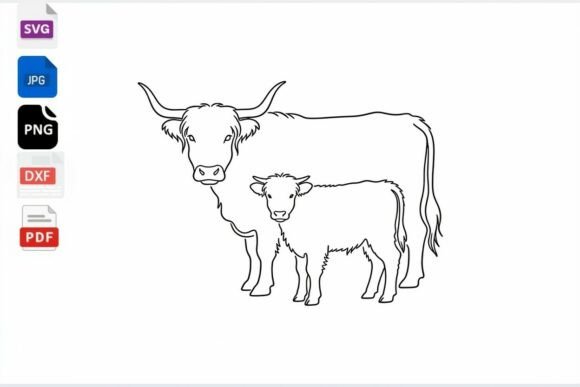
When I opened the Highland Cow Mom and Calf SVG Line Art, my immediate thought wasn’t “cute”—it was “confidently simple.” The line work is clean, uncluttered, and carries just enough character to feel hand-drawn without sacrificing precision. There’s a gentle asymmetry in the cow’s posture—the calf nestled close, head tilted upward—that reads as tender rather than stiff. As a designer who regularly selects embroidery files for client projects and small-batch merchandise, I appreciate how this balance of charm and clarity translates directly to stitchability. It doesn’t scream “busy,” which means it won’t fight your fabric, your thread, or your customer’s eye.
Where This Design Naturally Belongs
I recently used the Highland Cow Mom and Calf SVG Line Art to develop a limited-run embroidered tote bag for a local farm-themed boutique. The result? A soft, approachable statement piece—ideal for weekend markets or nursery decor. It also works beautifully on baby onesies (paired with a subtle running stitch outline), kitchen tea towels (where simplicity reads well at a glance), and lightweight aprons for artisanal bakeries or coffee shops. Because the design leans into line art rather than dense fill, it avoids the heaviness that can overwhelm delicate fabrics or small hoop sizes. That makes it especially strong for personalized gift projects—think holiday stockings, toddler caps, or stitched pillow covers for a rustic nursery.
Real Embroidery Behavior: What Holds Up—and What Needs Thought
In actual stitching, the Highland Cow Mom and Calf SVG Line Art shines on stable, medium-weight fabrics like cotton twill, linen blends, and mid-weight denim. On a sweatshirt, I paired it with a light tear-away stabilizer and a 40-weight polyester thread—clean lines held their shape, and the curves flowed smoothly under the needle. As a machine embroidery design, it behaves predictably: no excessive jump stitches, no tiny interior details that vanish at 3–4 inches wide.
That said, caution applies in a few real-world contexts:
- Stretchy or textured fabrics—like jersey knits or heavy terry cloth—require extra stabilization and possibly a slightly wider satin stitch border if you’re converting the line art into an applique design.
- Dark fabric backgrounds demand thoughtful thread color choices; light ecru or oatmeal thread reads warmer and more natural than stark white, especially for the calf’s muzzle or hooves.
- Curved surfaces (caps, curved tote handles) benefit from slight simplification—trimming the outermost hairline detail before digitizing helps prevent distortion.
- Frequent-wash items (baby clothes, kitchen towels) respond best when the design is stitched with high-quality thread and a balanced stitch density—not too sparse, not overly dense.
How It Elevates Your Finished Product—Beyond Just Looks
This isn’t just about prettiness. The Highland Cow Mom and Calf SVG Line Art strengthens perceived value because it feels intentional—not generic, not clip-art-y. Customers notice that. When used on a handmade product like an embroidered patch or custom apparel, it signals care in curation. For Etsy sellers and craft business owners, that translates to higher trust, better reviews, and repeat buyers who recognize your brand’s visual consistency.
It also supports storytelling. A Highland cow evokes heritage, resilience, and quiet warmth—qualities that resonate in holiday embroidery, wedding gifts (think “farm-to-table” couple favors), or even boutique branding for yarn shops or Scottish-inspired goods. And because it’s rooted in line art—not photorealism—it scales gracefully across formats: from a 2-inch pocket patch to a 6-inch tote centerpiece, without losing legibility.
Practical Notes Every Embroidery Designer Should Run Through
Before cutting thread or loading your hoop, here’s what I always do with a new digital embroidery file like this one:
- Test on scrap fabric first—especially if using textured or dark material. See how the line weight holds up after washing and drying.
- Check thread color contrast in both natural and artificial light. A warm gray or heather brown often reads richer than black on cream canvas.
- Review stitch density in your embroidery software. If converting to fill stitch or satin stitch, avoid overloading small areas like the calf’s ear or tail tip.
- Confirm hoop size compatibility. At its default scale, this design fits comfortably in a 4×4 hoop—but verify before resizing for larger applications.
- Inspect fine corners and junctions. Line art can sometimes produce unintended overlaps or gaps when scaled down; zoom in and smooth where needed.
- Test in black-and-white mockups to assess silhouette strength—this design passes easily, but not all do.
- Compare light and dark fabric backgrounds side-by-side. Does the mood shift? Does it still feel cohesive with your brand palette?
- Use proper stabilizer—light cut-away for knits, tear-away for stable wovens. Skipping this step undermines even the strongest embroidery file.
- Verify licensing before selling finished items or digital products. Since this is listed as a Graphics asset in the Crafts category, confirm whether commercial use is included—don’t assume.
Final Thought: A Quiet Workhorse, Not a Flashy Gimmick
The Highland Cow Mom and Calf SVG Line Art won’t dominate a trade show booth—but it will quietly earn repeat orders from customers who value authenticity, subtlety, and craftsmanship. It’s the kind of design asset that builds a cohesive collection: pair it with a simple Scottish thistle motif, a minimalist tartan stripe, or a handwritten “Mama & Me” script, and you’ve got a full line of nursery decor, personalized gifts, or small shop merchandise. For embroidery designers and creative entrepreneurs alike, it’s less about what the design *is*, and more about what it *enables*: thoughtful making, confident selling, and real connection—one stitched line at a time.