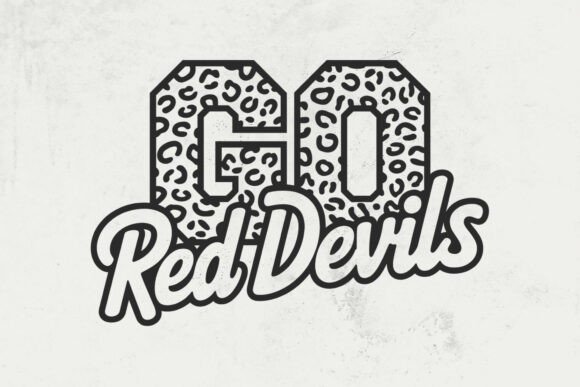
Go Red Devils Leopard SVG
As a designer who’s digitized, stitched, and sold hundreds of embroidery files over the past 12 years—mostly for small shops, Etsy sellers, and custom apparel studios—I opened Go Red Devils Leopard SVG, Go Red Devils expecting bold energy. What I found wasn’t just spirited school spirit—it was a design with real stitching personality: playful leopard texture layered under clean, confident lettering that reads instantly, even at 3.5 inches wide.
A Leopard That Stitches Like It Means It
This isn’t a generic “leopard print + text” combo slapped together for speed. The leopard motif in Go Red Devils Leopard SVG, Go Red Devils uses subtle, irregular spot placement—not rigid repeats—so it avoids that flat, clip-art feel. When converted to machine embroidery, those spots translate well into short satin or fill stitch clusters. I tested it on a medium-weight cotton twill tote bag (a staple for local boutique merch), and the texture held up beautifully—no bleeding, no thread nesting—especially when paired with a lightweight cutaway stabilizer.
The “Go Red Devils” lettering is the anchor: thick, slightly rounded sans-serif with open counters and generous spacing. That matters more than you’d think. On sweatshirts? It stays legible. On baby onesies? No tiny serifs to vanish in dense fill. On caps? It scales down cleanly if you reduce it thoughtfully—not below 2.75", though. Anything smaller starts compressing the inner curves of the “R” and “D”, risking lost definition.
Where It Shines—and Where It Needs a Second Look
Go Red Devils Leopard SVG, Go Red Devils works best where energy meets clarity: custom apparel for school spirit weeks, embroidered patches for cheer squads, holiday gift sweatshirts, and boutique kitchen towels for local sports bars. I recently used it on a navy French terry crewneck—the contrast between the warm red thread and deep background made the leopard spots pop like they were hand-painted.
But let’s be real: it’s not ideal for every surface. On thin, stretchy jersey tees? You’ll need tear-away + topping, and even then, avoid placing it near side seams or hems where fabric movement distorts stitch tension. On dark fabric, stick with high-contrast thread (e.g., bright red or white) and skip metallics—they mute the leopard texture. And while it *can* go on curved surfaces like structured caps, keep it centered above the bill—no wrap-around attempts. The design’s width and visual weight don’t balance well on tight curves.
Also worth noting: this is a graphics-style file—not an appliqué design. There’s no built-in fabric layering or raw-edge treatment. So if you’re planning embroidered patches or iron-on transfers, you’ll need to digitize your own backing or add a border stitch manually. It’s a clean digital embroidery file, yes—but it assumes you’re comfortable adjusting density or adding underlay for specific fabrics.
What Your Customers—and Your Business—Will Actually Notice
When someone sees a tote bag or apron stitched with Go Red Devils Leopard SVG, Go Red Devils, they don’t see “SVG file.” They see attitude, identity, and care. The leopard adds warmth and approachability; the bold lettering delivers instant recognition. That combination builds trust—especially for craft businesses selling personalized gifts. A mom ordering a “Cheer Mom” sweatshirt doesn’t want generic flair. She wants something that feels handmade *and* intentional. This design delivers both—if you stitch it right.
For Etsy sellers, it’s a smart mid-tier asset: distinct enough to stand out in search (“red devils leopard”), but versatile enough to reuse across seasons (spirit week → homecoming → holiday game day). Just avoid overusing it on low-contrast backgrounds—gray heather tees with burgundy thread fade fast in mockups and in person.
Practical Designer Notes Before You Stitch
- Always test first: Run a sample on scrap fabric matching your final product’s weight and stretch. Watch how the leopard spots behave at your chosen size.
- Check stitch density: If your machine flags high-density areas (common around letter junctions), reduce fill density by 5–8%—not enough to weaken impact, just enough to prevent puckering.
- Hoop size matters: The full layout fits comfortably in a 5x7 hoop. If you’re resizing for baby items or keychains, confirm the smallest readable version holds up at 2.5" before committing.
- Stabilizer strategy: Cutaway for knits and heavy wear items (tote bags, sweatshirts); tear-away for stable wovens (tea towels, pillow covers).
- Thread color contrast: Test black-and-white mockups. Does the leopard still read? Does the red “Go Red Devils” hold its own on maroon or charcoal?
- Licensing check: Since this is a digital download in a ZIP file, verify whether the license permits commercial use of finished products—or resale of the file itself. Many crafters assume “digital file = unlimited use,” but that’s rarely true without explicit terms.
Final Thought: A Design That Sells Itself—If You Respect Its Rhythm
Go Red Devils Leopard SVG, Go Red Devils doesn’t shout. It grins. It leans in. It belongs on the things people keep: the apron worn during tailgates, the pillow cover gifted to a new grad, the patch sewn onto a backpack that survives four years of campus life. As a crafts professional, I value designs that look as good stitched as they do on screen—and this one does. But like any strong graphic, it rewards attention to detail: proper stabilizing, smart sizing, thoughtful thread selection. Get those right, and what you’re really selling isn’t just a logo—it’s pride, belonging, and a little bit of wild joy, perfectly stitched.